Top Homeopathic Remedies for Acne
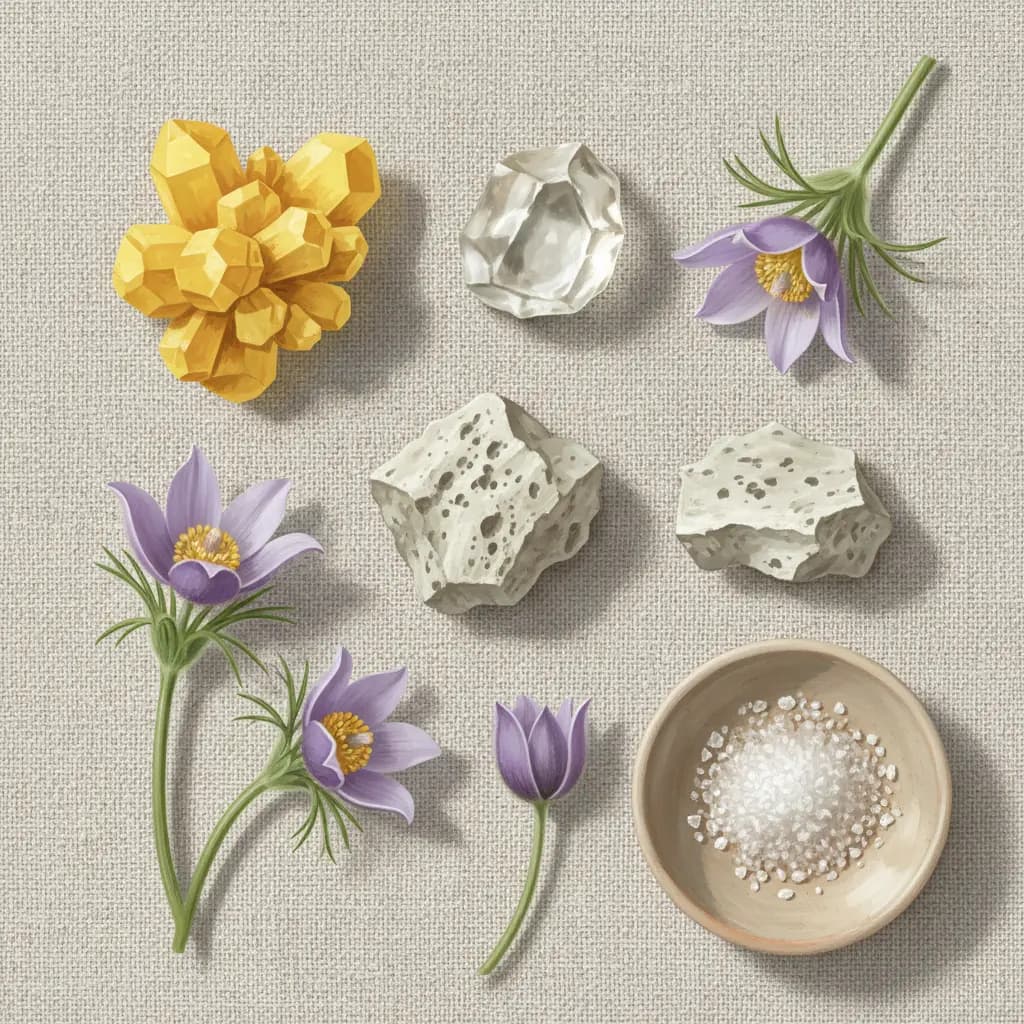
Acne rarely arrives alone. The breakouts come with a temperament, a thermal pattern, a hormonal rhythm, a food story, and often a hidden emotional thread. Two patients with identical-looking pustules can need entirely different remedies, and the prescription depends on which of those threads is loudest. Below are five remedies practitioners reach for most often — each with a distinct picture so you can begin to see where your own case sits.
Why a single "acne remedy" doesn't exist
Homeopathy treats the patient, not the eruption. The eruption is read as one of the self-expressions of the organism — a surface sign of a pattern that includes temperature sensitivity, food cravings, menstrual rhythm, and mood. Suppressing it with topicals tends to drive the pattern inward; matching it with a well-chosen remedy invites the self-governing principle to reorganize the picture from within. Get the person right and the eruption usually follows.
1. Sulphur
Sulphur is the great remedy of unhealthy skin — skin that breaks out at the slightest provocation, where every little scratch suppurates, where rough red patches sit beside fresh pustules. The acne itches and burns. Bathing makes it worse. The warmth of the bed at night makes it unbearable, and the patient throws the covers off, scratches until the skin bleeds, and feels burning afterwards. Chronic relapsing acne — treated, suppressed by creams and antibiotics, returning in waves — points strongly to Sulphur.
The Sulphur patient is typically hot rather than chilly, hungry around 11 AM with a sinking sensation, prone to red lips and red ear margins. Pustules sit on a rough, dry, scaly base.
Worse: warmth, warmth of bed, washing, bathing, 11 AM, night, wool against skin, suppressive treatments Better: dry warm weather, open air, motion
2. Silica
Silica is the remedy for slow, deep, cystic acne — the kind that develops as a hard lump under the skin and takes weeks to come to a head before finally suppurating and discharging. The pus is thick, the lesions heal slowly, and the patient often forms keloid-like scars. What distinguishes Silica is the constitutional ground: the patient is chilly to the point of sensitivity to drafts, refined and delicate in build, with fine hair, brittle nails that flake or have white spots, and feet that perspire offensively. There is often a quiet, conscientious anxiety — the perfectionist student, the meticulous worker who lacks "grit" and feels easily overwhelmed.
This is the remedy when the body lacks the force to expel — when boils and cystic lesions linger because the organism cannot complete the suppurative process cleanly. Silica helps the discharge mature and the tissue rebuild.
Worse: cold, drafts, uncovering the head, new moon, suppressed perspiration, milk Better: warmth, wrapping the head, summer, hot weather
3. Hepar Sulphuris
Hepar Sulphuris covers a different pus picture: the acutely painful, pus-laden pustule that is so exquisitely sensitive to touch the patient cannot bear even a sleeve brushing against it. The lesions throb. They sting like splinters. Cold air on the face is intolerable — the patient walks indoors with a scarf pulled high even in mild weather. Pus, when it forms, is offensive and copious. Where Silica is slow and deep and quietly suppurating, Hepar Sulph is loud, hot-with-cold-sensitivity, and acutely irritable both physically and temperamentally — the patient is often touchy, easily offended, and impatient.
It pairs especially well with acute flares riding on top of a chronic Silica or Sulphur pattern: Hepar Sulph for the angry painful lesion in front of you, the deeper remedy for the constitutional ground beneath.
Worse: cold air, cold drafts, slightest touch, lying on painful side, uncovering, night Better: warmth, wrapping up, damp wet weather, after eating
4. Pulsatilla
Pulsatilla is the classical remedy for hormonal acne in the mild, weepy, yielding young patient. The breakouts arrive or worsen with puberty. They flare in the week before menses and fade afterwards. Rich food — pastry, cream, pork, ice cream, fried food — provokes them within a day or two. The skin itches when the patient gets warm, especially in a stuffy room or under heavy bedding, and the eruption shifts location, moving from forehead one week to chin the next.
The temperament is the giveaway. The Pulsatilla patient is gentle, easily moved to tears, seeks reassurance and company, and feels visibly better after a good cry or a walk in the open air. They are thirstless even with a dry mouth. They love the windows open. When a teenager arrives with cyclical breakouts and that soft, dependent emotional quality, this is often the remedy.
Worse: warmth, stuffy rooms, rich and fatty foods, before menses, evening, lying on left side Better: cool open air, gentle motion, cold applications, consolation
5. Natrum Muriaticum
Natrum Muriaticum addresses a quieter, more chronic acne — the one that arrives or worsens on a background of unspoken grief or prolonged emotional reserve. The patient often describes a precipitating loss or disappointment they did not fully process, and the skin pattern dates from that period. The T-zone is oily, the forehead shines, blackheads collect along the hairline, and small pustules sit on a greasy base. The lower lip may crack down the middle. Cold sores cluster during stress.
Salt cravings are characteristic. The patient prefers solitude when distressed, dislikes being consoled (sympathy often makes them worse or tearful), and may carry old hurts for years. The acne here is one expression of a wider pattern of suppressed feeling.
Worse: sun, heat, consolation, 10 AM, grief, mental exertion, seashore (for some) Better: open air, cool bathing, rest, going without regular meals, lying on the right side
When the case needs constitutional prescribing
Each portrait above describes a tendency, but a real case rarely sits cleanly inside one. The Pulsatilla acne in a teenager may give way to a Natrum Muriaticum picture in their twenties after a difficult breakup. The Sulphur patient whose acne has been suppressed for years may need Silica first to restore the organism's capacity to discharge. Constitutional prescribing — assessing the totality of symptoms across history, temperament, and physiology — is how a homeopath identifies the simillimum, the remedy matching not just the breakout but the whole pattern producing it.
Persistent cystic acne, severe scarring, or breakouts tied to suspected hormonal disorders warrant a full case-taking with a qualified practitioner.
Related reading
- Homeopathic Remedies for Acne — full condition page
- Sulphur — remedy profile
- Pulsatilla — remedy profile
- Natrum Muriaticum — remedy profile
- Best Homeopathic Remedies for Skin Conditions — a cross-cutting listicle covering the wider skin picture
References
- Boericke, W. Pocket Manual of Homoeopathic Materia Medica. 9th ed. B. Jain Publishers, 2002. Entries: Sulphur, Silica, Hepar Sulphuris Calcareum, Pulsatilla, Natrum Muriaticum.
- Kent, J.T. Lectures on Homoeopathic Materia Medica. B. Jain Publishers, 2006.
- Clarke, J.H. A Dictionary of Practical Materia Medica. B. Jain Publishers, 2000.
- Hering, C. The Guiding Symptoms of Our Materia Medica. B. Jain Publishers, 1997.
