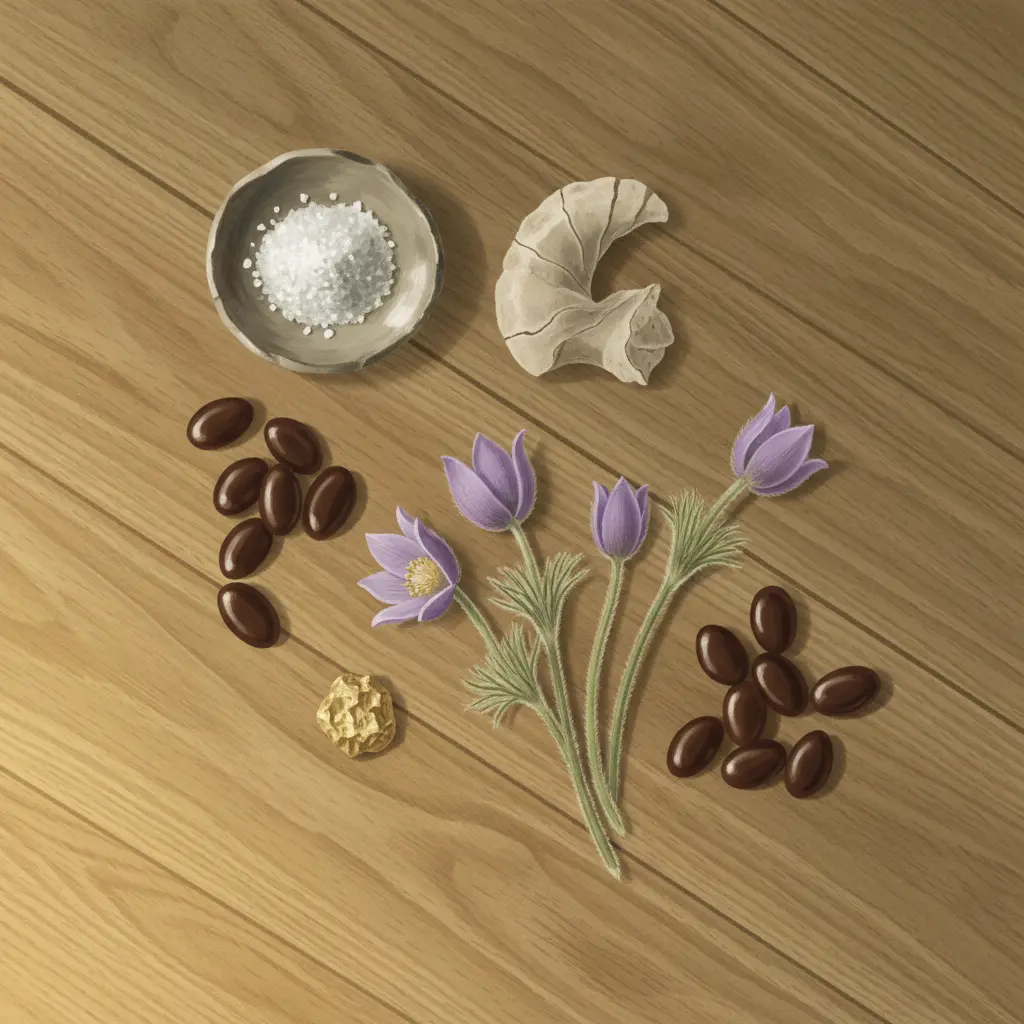
Top Homeopathic Remedies for Depression
Depression rarely looks the same in two people. One woman sits composed and dry-eyed, describing a grief from fifteen years ago that nobody has heard her name. Another weeps the moment she sits down and brightens when her sister puts a hand on her shoulder. A third has stopped feeling anything at all toward the children she adores — and is more frightened by that flatness than by any sadness. Homeopathy reads these self-expressions of the organism as a whole, matching a remedy to the particular shape the depression takes.
Why homeopathy for depression
Every depression has its own signature. The salt craving that appears six months after a loss. The relief of a long walk taken almost in fury. The dread of an empty house at dusk. These are not background details; they are the materia medica speaking the patient's own language back to her. A well-chosen remedy does not paper over suffering. It allows the self-governing principle to move what has settled — grief, exhaustion, despair — through rather than lock it in. Homeopathic care for depression works best as part of a broader mental health picture: integrated with talking therapy, with a prescribing physician's care when medication is part of the plan, and with crisis support when severity demands it.
Top remedies
Natrum Muriaticum
Natrum Muriaticum is the first remedy practitioners consider for the chronic, silent depression that has gone underground. A grief — bereavement, broken trust, an old wound nobody else remembers — has walled itself off and become the architecture of the personality. The patient dwells on the past, replays slights from years ago, holds grudges quietly. She cannot cry in front of others; tears come only in the car alone. Consolation aggravates — kind words feel like pity, and the walls snap shut tighter. A pronounced craving for salt, dark circles under the eyes, a crack in the middle of the lower lip, and migraines that run from sunrise to sunset often accompany the emotional picture.
Worse: consolation, sun, 10 a.m., heat, music, talking about the loss. Better: open air, being alone, cool bathing, going without meals, weeping unobserved.
Sepia
Sepia presents a depressive picture that is, in some ways, the most painful for the patient to admit. The hallmark is a disturbing indifference toward the people she normally loves — partner, children — combined with a deep exhaustion that has nothing left to give. She recognizes the flatness is wrong; she cannot summon the feeling back. The remedy is often indicated in hormonal contexts — postpartum, perimenopause, premenstrual depression — where a woman who has been holding the household together finally cannot. Sympathy makes things worse. What helps, paradoxically, is vigorous movement: a hard run, a long swim, a dance class she dragged herself to. She returns lighter than she left.
Worse: consolation, cold damp weather, before menses, after childbirth, sitting still, mornings. Better: vigorous exercise, dancing, warmth of bed, eating, occupation.
Ignatia
Ignatia is the foremost remedy for acute reactive depression — the depression that arrives like a wave after a specific blow. A sudden bereavement, a breakup, an unexpected loss of work or status. The picture is full of paradox. Silent sobbing that breaks into long-drawn involuntary sighs. A lump in the throat that will not swallow away. Laughter that turns mid-word into tears. Symptoms contradict themselves — a sore throat that feels better swallowing solids. Consolation makes things worse. Where Natrum Muriaticum is the chronic, walled-off grief, Ignatia is the fresh emotional shock — and the two often appear in sequence, Ignatia opening the case and Natrum Muriaticum completing it months later.
Worse: consolation, coffee, tobacco, morning, strong odors, suppressed emotion. Better: being alone, deep breathing, eating, warmth, hard pressure.
Pulsatilla
Pulsatilla is the emotional counterpoint to Natrum Muriaticum, and the difference is diagnostic. The Pulsatilla patient in depression weeps openly, seeks company, wants to be held, and feels better from sympathy. Moods shift fast — tears give way to a half-smile and back within an hour. The forsaken feeling runs deep; she narrates the loss in detail and cries more as she tells it, and the crying relieves her. She does poorly alone in a warm stuffy room; she wants fresh air and a friend beside her. When a depressed patient brightens the moment her hand is held, Pulsatilla is on the shortlist.
Worse: warm stuffy rooms, evening, rest, rich food, being alone, before menses. Better: fresh air, gentle motion, consolation, company, cold applications.
Aurum Metallicum
Aurum Metallicum addresses the gravest depressive picture in the materia medica — a deep, settled despair that often appears in driven, accomplished people. The Aurum patient has held himself to extraordinary standards: the surgeon who lost a case, the executive after a public failure, the artist who has stopped believing his work is worth anything. The collapse, when it comes, is total. He feels worthless, a burden. Religious or moral remorse may overtake him — convictions that he has sinned, that he is being punished. Suicidal ideation is part of the picture; the materia medica describes a longing to throw oneself from heights. Crucially, he weeps without consolation — sympathy does not reach him. This is a remedy for an experienced practitioner working alongside the patient's full mental health team, never as a self-prescription, and never in isolation from crisis support when suicidality is present.
Worse: night, cold air, mental exertion, contradiction, grief, after disappointment. Better: open air, music, walking in cool air, warmth in bed.
When the case requires constitutional prescribing
Acute self-prescribing — Ignatia 30C in the first days after a loss, or Pulsatilla 30C during a bout of weeping — is within reach of careful readers of the materia medica. Depression as a sustained state is a different matter. When a low mood has settled into the constitution, shaping sleep and appetite across months or years, the prescription needs to match the whole person. A trained practitioner takes the full case, repertorizes the totality, considers miasmatic background, and works in ascending potencies as the picture clears.
Homeopathy does not replace the rest of the mental health picture. Patients on antidepressants can begin homeopathic treatment without stopping medication; changes to conventional prescriptions are decisions for the prescribing physician. Patients in talk therapy frequently find that the two approaches reinforce each other. And when depression reaches the severity of active suicidality, crisis services (988 in the US, or local emergency lines internationally) are the first call. Homeopathic care continues as part of the broader plan, not in place of it.
Related reading
- Depression — condition overview
- Natrum Muriaticum — remedy profile
- Sepia — remedy profile
- Best Homeopathic Remedies for Stress and Burnout — the adjacent listicle for exhaustion-driven low mood
- Best Homeopathic Remedies for Nervous System Health — for sleep, agitation, and the broader neuro picture
References
- Boericke, W. Pocket Manual of Homoeopathic Materia Medica. 9th ed. B. Jain Publishers, 2002. Natrum Muriaticum, Sepia, Ignatia, Pulsatilla, Aurum Metallicum.
- Kent, J.T. Lectures on Homoeopathic Materia Medica. B. Jain Publishers, 2006. Natrum Muriaticum, Sepia, Aurum Metallicum.
- Clarke, J.H. A Dictionary of Practical Materia Medica. B. Jain Publishers, 2005. Ignatia, Pulsatilla, Aurum Metallicum.
- Hering, C. The Guiding Symptoms of Our Materia Medica. B. Jain Publishers, reprint 2003. Natrum Muriaticum, Aurum Metallicum.
