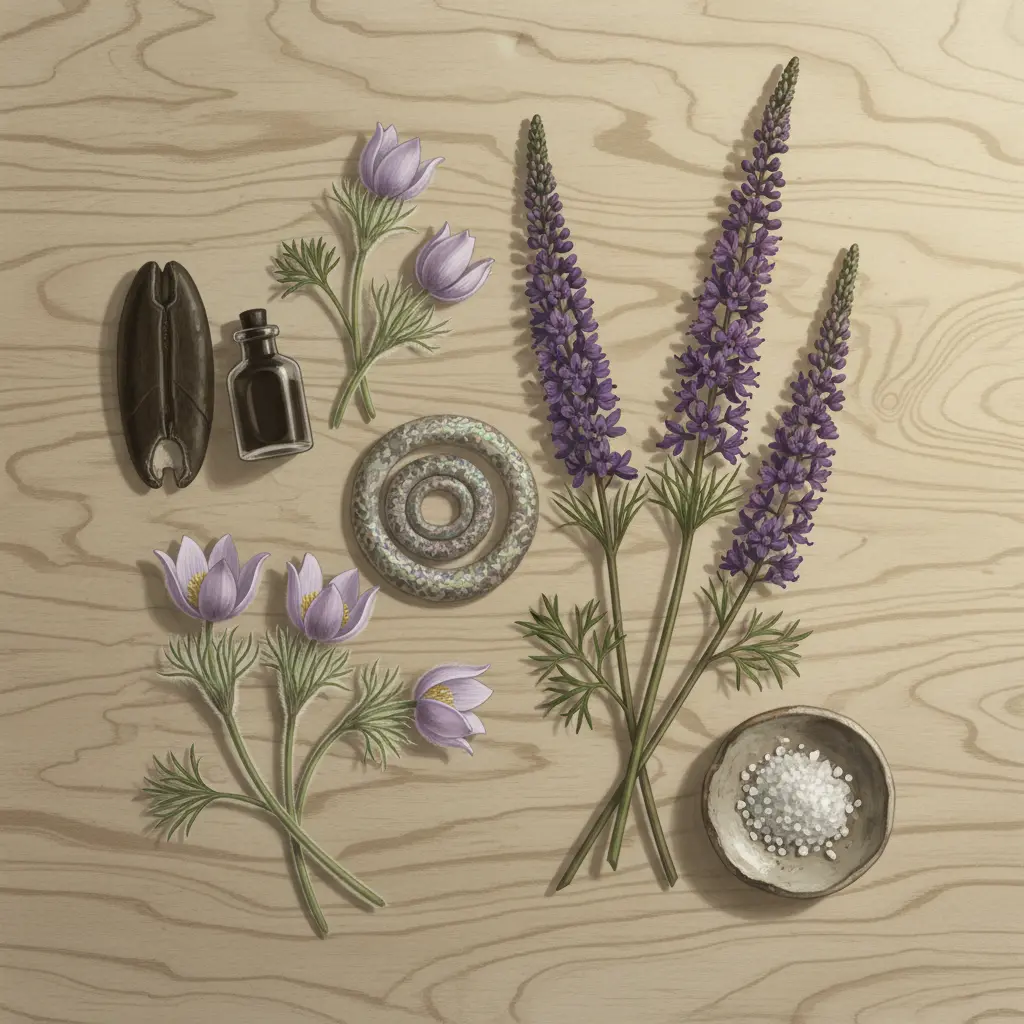
Homeopathic Remedies for Perimenopause
Menopause is a date on the calendar — twelve months without a period, looking backward. Perimenopause is the road that gets you there, and it is rarely a straight one. Cycles that arrive twice in a month, then skip a season. Flooding one month, spotting the next. A hot flush at a meeting in your early forties, years before anyone has said the word "menopause" out loud. Homeopathy reads this turbulence not as a system breaking down but as the self-governing principle renegotiating its terms, loudly, and the remedies below are the ones practitioners reach for when that renegotiation turns rough.
The transition, not the destination
What makes perimenopause its own clinical picture is the swing. Ovulation becomes intermittent, oestrogen and progesterone stop moving in their old paired rhythm, and the body's self-expressions follow suit — heat then chill, weeping then irritability, deep sleep then 3 a.m. wakefulness. A practitioner reading the case is listening less for any single symptom than for the shape of the instability: which direction the woman tips when her cycle lurches, what she becomes when she is most herself under strain. That shape is what points to the remedy. The same hot flush belongs to three different women, and three different remedies, depending on everything around it.
This is also why the menopause prescription and the perimenopause prescription often differ. Once periods have stopped, the system has settled into a new steadiness, however unwelcome. In perimenopause the ground is still moving, and remedies that match changeability itself — not just heat, not just low mood — tend to earn their place.
Sepia: the great remedy of the transition
If perimenopause has a leading remedy, it is Sepia. The picture is one of a woman worn out — not dramatically ill, but drained, flat, dragging. Hahnemann's materia medica calls it preeminently a woman's remedy, acting on the female pelvic organs and on the venous circulation that slackens as hormones fall. The keynote that practitioners trust above all is the indifference: the woman who has stopped being able to summon feeling for the people she loves most, who answers her own children with a short word because she has nothing left to give. She knows it isn't right. That awareness, paired with the flatness, is the signature.
Physically, Sepia carries a heavy, bearing-down sensation in the pelvis, as if everything might drop, often better for crossing the legs. There are hot flushes that rise and end in a faint, weak sweat. Cycles in the Sepia woman swing toward the extreme — irregular, sometimes early and profuse, sometimes scanty and late, with a tendency to drag on. And there is one modality that separates Sepia from nearly every other exhausted remedy: she is better for vigorous exercise. The woman who can barely face the day but comes back from a hard run or a dance class momentarily restored is showing you Sepia in a single observation.
Worse: cold, before menses, consolation, overwork, standing Better: vigorous exercise and dancing, warmth, drawing the limbs up
Lachesis: heat that hates constriction
Where Sepia goes flat, Lachesis goes hot, talkative, and intense. This is heat that rises — flushes that climb the chest and neck into the face and crown, often worst on waking or just as she falls asleep. The hallmark modality, found throughout the snake-venom provings, is an intolerance of anything tight: she loosens her collar, can't bear a waistband or a scarf, sheds the bedclothes. The throat and the liver region are especially sensitive to pressure.
The emotional picture is loquacity and intensity — thoughts crowding out one another, suspicion, a jealous edge that surprises even her. The single most reliable perimenopausal keynote is the relationship to the cycle: everything is worse before the menses and relieved once the flow begins. The flush, the headache, the black mood lift the moment the period arrives. In a transition where periods are growing erratic, that "relief on flowing" can become a recurring, dramatic see-saw. Lachesis is also classically worse for warmth and stuffy rooms, and reaches for open air.
Worse: before menses, on waking, heat, tight clothing, suppressed flow Better: the onset of menstrual flow, open air, cool drinks
Pulsatilla: changeable everything
If one remedy embodies the perimenopausal swing, it is Pulsatilla — the "weathercock" of the materia medica, named for symptoms that shift from hour to hour and never sit still. No two days alike: tearful in the morning, fine by afternoon, chilly yet craving an open window, hungry without knowing for what. The cycles are the most erratic of any remedy here — late, scanty, changeable, sometimes vanishing for months and returning without warning.
The emotional keynote is gentle and unmistakable: she is weepy, and she is better for company and comfort. Consolation actually helps — a striking contrast to Sepia, who wants to be left alone, and to Natrum Muriaticum, who weeps but recoils from sympathy. The Pulsatilla woman can hardly describe her symptoms without tears, and a hand on the shoulder eases them. Her heat is real but she is rarely thirsty, and she feels worse in warm, stuffy rooms, dramatically better in cool fresh air. For the woman whose perimenopause is defined less by a single complaint than by sheer unpredictability — of mood, of cycle, of appetite — Pulsatilla often fits the whole.
Worse: warm stuffy rooms, evening, rich fatty food, before menses Better: open air, gentle motion, consolation and company, cool applications
Sulphur: heat that burns to the surface
Sulphur belongs to the woman whose perimenopause is dominated by heat that pushes outward. The flush rises to the head, the face flushes easily, and the classic keynote appears at the other end of the body: burning soles that she pushes out from under the covers at night. There is a constant heat on the top of the head, broken sleep, and often a thirst and a hankering for something cold. She may be intolerant of standing, restless, quick-tempered — heat in the temperament as much as the body. Sulphur frequently helps the perimenopausal picture that is, in the old phrase, worse for warmth in every direction: heat of the bed, heat of the room, heat rising within.
Two more worth knowing
Not every useful remedy has a full profile on this site yet, and two deserve a mention in any honest account of the transition.
Sanguinaria canadensis is a focused flush remedy. Its signature is a circumscribed redness — burning cheeks that flare in distinct patches, with flashes of heat and, characteristically, burning palms and soles at menopause. It is a right-sided remedy, often tied to sick headaches that climb from the occiput over the right eye and worsen with the sun. When the perimenopausal complaint is the vasomotor flush itself — sudden, hot, with mapped redness on the face — Sanguinaria is one to consider.
Cimicifuga racemosa (black cohosh) is the remedy of perimenopausal gloom. Its defining mental state, repeated almost word for word across the old sources, is the sensation that a black cloud has settled over everything — a heavy dejection with a fear of going crazy, the sense of impending evil. It is suited to the menopausal period in nervous, rheumatic women, with cramping uterine and ovarian pains that wander from hip to hip, irregular and painful menses where more flow brings more pain, and a low mood that worsens with the cycle. Where Sepia's pelvic dragging comes from slack, lost tone, Cimicifuga's comes more from cramp and contraction — a useful distinction at the prescribing table.
When the case needs constitutional prescribing
Self-prescribing a 30C for an occasional flush is reasonable. But perimenopause is a years-long shift in the whole organism, and the deepest results usually come from constitutional prescribing — a practitioner taking the full case and choosing the remedy that matches not just the flush but the woman it belongs to. The instability that makes this stage hard to live through is exactly what makes a well-chosen remedy worth the consultation: one that meets the swing itself rather than chasing each symptom as it surfaces.
Related reading
For the full clinical picture once periods have stopped, see the menopause condition page. For the flush itself across remedies, see Best Homeopathic Remedies for Hot Flashes, and for the wider endocrine view, Best Homeopathic Remedies for Women's Hormonal Health. When the transition brings cramping or painful periods, Best Homeopathic Remedies for Menstrual Cramps covers the differentiation in detail.
References
Boericke, W. Pocket Manual of Homoeopathic Materia Medica. 9th ed. B. Jain Publishers, 2002.
Clarke, J.H. A Dictionary of Practical Materia Medica. Homeopathic Publishing Company, 1900.
Hering, C. The Guiding Symptoms of Our Materia Medica. Estate of Constantine Hering, 1879.
